Showing posts with label Plants. Show all posts

Thursday, May 5, 2011

"What the...?" Part 1

Once upon a time, I started to write a blog post that went like this:


Recently I went to, according my zero research, the world's largest antique fair(!!!) in Round Top, TX.  Fried pickles, fried mushrooms, funnel cake, fresh fried pork rinds, and popcorn may or may not have been devoured ravenously.


We may or may not have found the perfect vintage accessories.
While in town, in a pine forest, I also happened upon a cut in the soil that showed the native clay a few inches below. It had weird yellow veins going through it.  The veins were very fine grained, like a flour-fine powder.  I dug deeper to see if they thinned out, but after several inches of digging through dry clay, the veins were still there.  Can you see them below?


You don't see the yellow veins?  Let's try again, with "magnification."
OK? 
OK.
"What the...?" I was being SoilDuck's good kind of stupid: stupid yet curious.
Internet research was boring, so I checked in with my fellow twits, to see what they thought.  Here were some ideas:
 I forgot to mention that there was something else interesting too: a white crystalline crust on the outer surface of the clay.

Here is your first official look at the '"mystery of nature" observed under a stereoscope.
See? It is right there, under the stereoscope.
(Thank you, young scientist, Manuel Lopez for taking this picture.
Thank you Mr. Moldyenhaur for setting up the learning apparatus.
Thank you Eastside Memorial HS for hosting this scientific inquiry.)
Actually, were looking at the white crystalline crust here, not the yellow vein powder. Our computer screen is showing a blurry version of it.


But then I hit a stopping point.  I hit Publish anyway.  I hope this post finds you well, and if we don't chat sooner, Happy Mother's Day!  Thank you to both Granny Sharon and Mother Earth.

Join us next time, in "What the...?" Part 2, How do you identify a mystery substance?

Monday, December 13, 2010

The Dirt on Enchanted Rock, TX

An honor to be climbing with The Prez of the Texas Invasive Plant and Pest Council and The Lady that is responsible for my love of science (and wavy hair)
So, me and some lovies went to Enchanted Rock, Texas.  It reminded me of my last trip to Enchanted Rock, wayyyy too long ago with a precious godmother, or madrina, who was visiting for a baptism circa the spring equinox.  I also have many a memory of camping here during college.  Ergo, during this hike, I was twice filled with The Love: the lovies of the present, and the lovies of the past.    I will spare you the relevant Sesame Street video, but let's all agree, climbing Enchanted Rock is fun.

What is Enchanted Rock?  It is a big granite intrusion.  It's most common minerals, I believe, are microcline, plagioclase, quartz, and biotite.  You can follow a geological tour up the hill, it's nice.

Schmanyways, obvs there are associated soil photos, but first (!!!) here is what Enchanted Rock looks like from the road.
Since Texas is unfairly known for being quite flat, this is kindof a big deal.  Look, a protuberance!

A closer peek...

We climbed to the top and had some cool views.  

Forgive me because I have lots of pictures I want to share about an obsession I didn't really know I had: plants appearing to grow out of rocks (!!!).  

People in the know are calling them vernal pools.  Vernal pool ecology is created by pioneer species: they are the first to colonize a mostly abiotic area.
I like this pic: this is a vernal pool - the first inklings of entisol soil formation.
I think  that is an oak tree.  Sorry for my photo smidge on the right.  
Looking uphill, presumably native grass.
Same area.
Some cactus.

Spatial distribution.
The top.
According to the Texas Parks and Wildlife Department, the plants and animals that live here are "uniquely adapted to a harsh environment."
In fact, by studying weather pits, ecologists learn: (1) how plants and animals colonize a newly formed habitat;  (2) how those organisms modify their environment and help develop soils; and, (3) how plant and animal community structure and composition change over time.
In other words, they are super neat.
At Enchanted Rock you can see the progressive development from bare rock-bottom pits, to annual plant establishment, to miniature prairies with grasses like little bluestem and even trees like live oak. Vernal pools also support an interesting species of invertebrate, the fairy shrimp. These tiny animals survive total desiccation as fertilized eggs, and hatch into larvae and grow into adults each time water collects after sufficient rainfall.
Since these things are super cool, and their ecosystems are so fragile, the Texas Parks and Wildlife Department wants to make sure visitors are aware of their significance and asks them to back off
"STAY ON THE ROCK," they say.  And, 
"Thank you for protecting an important part of the Enchanted Rock experience."  
Look at the length of the root compared to the height of the above-ground portion (green leaves only).  This was on the bank of a dry creek bed.

Have a great visit!

P S.  Natural resources of Enchanted rock found here.

Friday, July 9, 2010

As the soil turns.

Hello dear readers! I went on a quick trip to Swallow Falls State Park in Maryland.  Swimming in the waterfall was so much fun!  I took a few pictures as I thought about the difference between rocks and soil.

There are 5 factors that work together to form soil:
  1. Parent material - It can be mineral and/or organic (i.e. decomposing plants).
  2. Climate -  Different environmental factors (i.e. temperature and precipitation) affect chemical and physical weathering
  3. Living organisms - Among other things, they help organic matter biodegrade, and can mix soil layers/horizons into each other.  Their chemical reactions can cause chemical weathering.
  4. Topography - For example, valleys accumulate soil and water, hilltops shed them.  This affects the type of soil created. 
  5. Time - Neat factoid: sometimes a very chronologically old soil won't be very developed, and vice versa.
For more, there are quick explanations at NASA and the NRCS.


The Soil Science Society of America gives us a two part definition of soil. This is the first part: 
 "The unconsolidated mineral or organic material on the immediate surface of the Earth that serves as a natural medium for the growth of land plants."
Below, I'm sharing with you my pictorial exploration of a plant's contribution to soil development.

Plant pioneers.  This guy might trap tiny rock fragments or organic debris which will grow his soil pile.  To be honest though, erosion is high here.  It was on a slope.  This soil might not develop further.

These guys have a small part in a very big process.  I imagine their roots will help make this crack a little bigger, making it able to hold even more soil, allowing even bigger plants to grow here in the future.

Growing sideways out of a crack between two rock layers.  Not much opportunity for soil development here, but don't tell her!

This shrub (tree?) has chutzpah.  It looks like it is growing out of the rock.

It looks like these guys are the furthest along in helping to develop soil, but they still have a looooong way to go!  When these plants die, they will contribute organic matter to the soil for new plants.  

Even if these little bits of soil are chronological Methuselahs, environmental factors prevent them from developing horizons.  Mayhaps erosion rates are faster than the rate of soil development.  If so, the soil would be characterized as an Entisol.  Entisols are the youngest (meaning least developed) of the 12 soil orders. 


And let's end on a lithologic music note...

Saturday, February 27, 2010

Why you wait to walk on wet soil

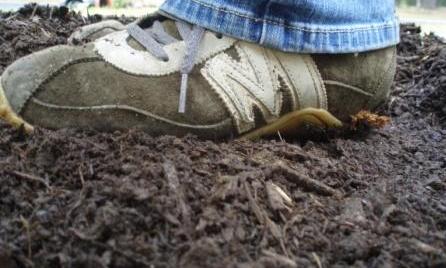
Our gardens love the rain! But be careful, wet soil is more vulnerable to compaction, especially clayey soils. The physical damage from compaction can
  • increase bulk density, where soil pores are now too small to accommodate the root cap's growth
  • increase soil's ability to resist deformation (soil strength), and prevent root penetration.
  • crushes natural soil aggregates and associated macropores, thereby preventing adequate water and air flow.
All this means reduced root growth and therefore less overall vigor of a plant, from your garden plants to large trees! Clay soils are more vulnerable to having their structure damaged due to their increased plasticity and cohesion. Try not to walk too much on your wet soils; perhaps make a permanent path in your garden to help you remember.

Here are some definitions:

Bulk density: weight per volume of soil
Soil Strength: ability of a soil to resist deformation (change in shape)
Plasticity: ability of a soil to be molded or deformed by pressure
Cohesion: stick/stay together
Soil aggregates: soil particles that are held together in one mass
Macropores: soil pores large enough to allow for air and water flow, and even some small animals (some animals make macropores!)
(reference)