Showing posts with label compost. Show all posts

Thursday, November 4, 2010

ATX: Your poo promotes birdwatching. Indirectly.

Birdwatching at Hornsby Bend (Photo credit: Meredith O'Reilly)
Hornsby Bend, Austin’s premier birding location, is a biosolids recycling facility.  

Say what? Your beatific contribution to the sewer system via flushing toilet travels through pipes and goes to a wastewater treatment plant. After treatment, the biosolids (or, if you want to sound like a nerd, primary and secondary waste-activated sludges) go to Hornsby Bend, where they are manipulated again ultimately composted with yard trimmings collected from Austinites to make Dillo Dirt (Read page 3 of this doc for more details on how this is done.)  The liquid waste portion of the biosolids make outdoor ponds, whose waters irrigate onsite fields.  

The birds love Hornsby Bend.  They like the ponds, the drying basins, woods and fields:
The biodiversity is present both because of the nutrient rich biosolids treatment  processes used by the facility and because of the diversity of habitats at the site stretching along 3 miles of the Colorado River. (source)
We built it, so they came, enjoyed, and returned.  And now we can go watch them. Meredith at GreatStems wrote a very nice blog post on Honsby Bend's birdwatching and history.

If you haven’t had a chance to visit Hornsby Bend's neat avian-friendly ecosystem, you should fer reals go. 

Here are some visiting tips:


You can go by your lonesome or join the group activities as listed on The Dirt on Soil's calendar, which include:
  • A monthly bird survey every 2nd Saturday of the month @ 7am,
  • Birder led "field trips" every 3rd Saturday of the month, and
  • Eco-literacy day every 4th Saturday of the month @ 9am -1pm
    • 3 hours of outdoor volunteer work; 1 hour of ecological education
Also, Hornsby Bend is open daily to the public from sunrise to suneset.

Wednesday, May 26, 2010

Those actinomycetes sure do smell good.

Here in ATX, it rained the other day.  And boy-oh-boy did it smell wonderfully refreshing.  It reminded me of a much-maligned kingdom (or domain, depending one what taxonomic ranking system you use): bacteria!  Although bacteria can get a bad rap, we can thank them (particularly the actinomycetes) for one reason behind that fresh rain smell.
Here are some potential causes of our odoriferous joy:  
Do you learn by listening? Listen here for an easy to understand explanation, covering the same stuff mentioned above. 

Besides that wonderful smell, there are other reasons why actinomycetes are awesome.  I imagine you've heard that bacteria such as rhizobium help legumes obtain nitrogen from the air.  Well, the actinomycetes genus Frankia helps non-legumes fix nitrogen from the air.  This means that they can help plants colonize infertile and newly forming soils.  Also, many actinomycetes can digest what others can't.  Those hard to decompose substrates such as chitin and cellulose are prime picking for these guys.  That is great news for compost with sawdust and branches!

Want more actinomycetes?  They can tolerate arid and salt-affected soils.  They work best in soils with a pH between 6.0 - 7.5, but are more sensitive to acidic soils.  Don't worry too much about acidity though, since fungi can take over the decay where actinomycetes leave off (info also from reference #1).

Also, this great article says that daily turning of compost, while good for some purposes, can inhibit growth of actinomycetes.  Although actinomycetes can either be mesophilic* or thermophilic*, they are mostly known to work in the later, cooler stages of compost creation.  If you see something that looks like gray spider webs in the outer edges of your compost, it just might be actinomycetes.  Please remember to say, "thank you!"  

Please enjoy your "rain smell" responsibly.
*Definiciones:


Mesophilic: microbes that function at temperatures above 113 °F


Thermophilic: microbes that function at temperatures between 50-113 °F (10-45 °C) (ref)

Tuesday, April 20, 2010

Something we can all agree on...COMPOST


Yes we can, agree.
Great pontification, dear readers reader! Decomposable compost is great for the soil, beyond just  soil structure improvements.  It does more than provide food for the soil microorganisms that help aid in aggregating soil.  Let us draw our attention to the mother of all soil amendments (please think out loud in a bellowing voice),  Compost!


  • It increases cation exchange capacity, 
  • improves structure, 
  • helps retain moisture, 
  • and provides nutrients! 
  • It can almost do no wrong!
As an aside, you can use manure to make your garden compost.  I am trying to help a friend learn about the nutrient profile of elephant and donkey poop manure for her bipartisan victory garden.  Ideas on where to find that info?

Here are some interesting links I found during my, so far unfruitful, search.

Friday, March 26, 2010

Why you need enough Nitrogen in your compost

This bird bath needs compost.
A major source of locally derived soluble nitrogen (N) for your plants is...the bacteria that eat your compost!   They live at a certain ratio of C:N (carbon to nitrogen).  Since there is usully enough C in the environment, these guys are usually hunting for N.  And if they can't find enough N in the environment around them (say, your compost bin), then they can't grow. So if your compost does not have enough N (too much C) , it won't break down very quickly.  But here is where your garden comes in- if you put fresh compost onto your soil that hasn't completely broken down, and there is not enough N in the compost for the bacteria to grow, then the bacteria will compete with your plants for the N in the soil water solution- no bueno!

Sources of nitrogen for your compost:
  • coffee grounds (just like manure, don't add directly to plants before composting!)
  • animal manure (make sure this cures, there could be disease)  
  • any more ideas?
This looks like a good place to add some Nitrogen!
If you don't have coffee grounds or animal manure, don't worry.  Most mature household compost has plenty of nitrogen (a ratio of 15:1 versus the maximum 25:1 ratio).  Just make sure you don't input too much "dry" stuff to your compost, such as dried up grass or leaves.  For example, sawdust, straw, and newspaper has WAY too much carbon to compost on its own.

Friday, March 12, 2010

Compost teaser

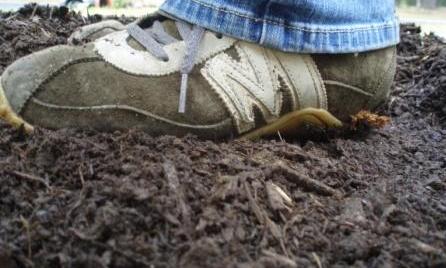
Indeed, my compost smells like roses.
A commenter recently asked how to get started on compost.  I haven't gathered all the necessary information yet, but I wanted to give you a quick factoid to get you interested. The time that it takes to transform your compost into usable nutrients for your plants can vary from days to years, depending on environmental conditions and contents of your compost.  The fastest way to get nutritive use from your compost  (there are other uses!) is to create the following conditions:

  • temperatures between 77 and 95 degrees Fahrenheit (25-35 degrees Celsius),
  • a pH close to neutral,
  • good soil moisture(within your volume of soil, about 60% of the void space is filled with water instead of air), AND
  • good aeration (reference).