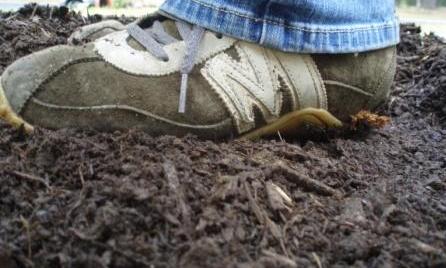
How are you today? Where are you today? You know,
So please, will you comment and introduce yourself? Or what you want to hear about next? Or a random thought? I'll pause and wait, to give you a moment to do that....
Waiting for you to comment gives me similar existential issues as those confronted by Grover and Telly Monster in "Waiting for Godot Elmo" by Sesame Street's Monsterpiece Theater.
Moving on, I have this little "6 degrees of soil separation" game going on in my head all the time. I believe you can link anything back to soil, just like Kevin Bacon. So today I am going to relate annoying small toads to the chemical structure of smectite*. I know, it's magic! Thank you ;-)
Moving on, I have this little "6 degrees of soil separation" game going on in my head all the time. I believe you can link anything back to soil, just like Kevin Bacon. So today I am going to relate annoying small toads to the chemical structure of smectite*. I know, it's magic! Thank you ;-)
First of all, let us let us focus our attention on a gentle, young, unsuspecting Bufo valliceps toad.
According to my research hubs, this toad is a Bufo Valliceps. I like to water my foundation, catch them, and gawk at them adoringly. I pour water onto the side of my house and they all come jumping out from the crack between the foundation and the soil.
I'm obsessed Perhaps you have heard of this soil here, here and here. Anyways, the crystal pattern for smectite involves adjacent planes, or sheets of oxygen (among other elements). And adjacent oxygens don’t “bond” with each other very strongly compared to say, hydrogen bonding [the polarity of water: discuss]. This means that when precipitation (rain) percolates into the soil, fresh soil water molecules have an opportunity to get all up in between the tetrahedal layers, which pushes the layers apart and increases the soil volume(!!!). Yes dude, the soil gets bigger, and in an annoyingly uneven way. "Le sigh," says my house.
Imagine, the soil under your house is a smectitic, and whenever it rains, the clay under your house expands, and shrinks when it doesn't. It is like building on ... some other slowly flowing (viscous) material. Your walls may crack, your door jams stick. Anyways, we water it in afutile? effort at keeping soil moisture nice and even at all times, which should supposedly preserve our foundation's integrity. And this is where the toads come in again.
In conclusion, our 6 degrees ofKevin Bacon separation:
PS These smectitic soils are characterized by high base saturation, partially explained here and here.
 |
| Actually, he indeed suspects, see why below. |
You see, when it doesn't rain, my clay shrinks to provide these naifs space to cuddle in a nice, moist resting area.
And when it doesn't rain, I water my foundation to get rid of the very same crack in which they reside (Does it help your foundation stability for reals? No idea).You see, this toad and my humble abode are located upon a smectite clay.
Imagine, the soil under your house is a smectitic, and whenever it rains, the clay under your house expands, and shrinks when it doesn't. It is like building on ... some other slowly flowing (viscous) material. Your walls may crack, your door jams stick. Anyways, we water it in a
In conclusion, our 6 degrees of
- I pour water onto the soil next to my house foundation so that it will expand to close the crack between the two. Toads hop out of the crack, annoyed (and then I catch them!). You see,
- Maintaining near constant soil moisture levels may preserve our foundation located on a smectite clay.
- Smectites change volume depending on soil moisture,
- Cuz their adjacent tetrahedral layers are only bonded by oxygen bonds and
- Water is more electrostatically attracted to the oxygens in between the tetrahedral layers than the oxygens are to each other.
- Once hydrated, the smectite clay mineral expands with the added molecules.
PS These smectitic soils are characterized by high base saturation, partially explained here and here.
Definiciones:
Smectite: A mineral found in great quantities in vertisols, which are known for their shrink swell capacity due to expanding 2:1 lattice clays (source).
Phyllosilicates: Silicates (atomic structures featuring silicon) that combine to form planar sheets.
P.S. They discovered phylosilicates on Mars.
Phyllosilicates: Silicates (atomic structures featuring silicon) that combine to form planar sheets.
P.S. They discovered phylosilicates on Mars.


