Showing posts with label watershed. Show all posts

Saturday, September 18, 2010

My Friday in Pictures

Yesterday, I helped at American Youthworks' inaugural "drainage ditch" garden groundbreaking.  
An American Youthworks teacher gardens.

Since the gardens are in the drainage ditch, they are watered by rain and from upstream surface and ground water flow.  The plants are in raised beds, adding water drainage and preventing their flooding during periods of heavy rain.  

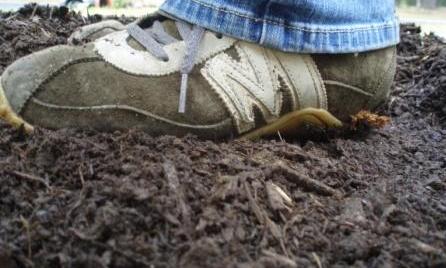
This garden is in an urban environment, which has  hydrological consequences.  As a  small scale watershed quality strategywe made sure to put  mulch (e.g. pine needles) on all bare areas.  

We weeded and sowed Fall appropriate seeds.  The shadow of yours truly is in the bottom left corner.
A look at their compost pile behind the basil.
This is one of my favorite pics from the day.  These little garden blessings were placed all around the garden.

I hope you are having a great weekend!  Tell me about it in the comments!

Thursday, August 26, 2010

11 things you can do to increase water in Austin creeks

This creek has high water flow during rain events; you can see the big pile of brush that the water carried.  But a day later,  it is sunny and the creek is dry (Fort Branch Watershed at Springdale Rd., I think).
We talked earlier about how one of the problems in local Austin streams is that they have too much water when it rains [which renders our poor froggies and fish practically habitat-less from all that turbulence], but not enough the rest of the time.  This, in part, is caused by how we have developed impermeable cover on top of our soil.  Basically, we've become urban.  For more details, please read my post on Watersheds in a nutshell in a nutshell.  Thanks!  Now onto the proactivity...

There are ways we can help those little froggies and fish keep their homes, and it doesn't have to be done by big groups of people.  Each yard can make a difference!  All we have to do is point water in a new direction, away from runoff and evaporation, and towards infiltration into the soil and groundwater.  When water is supplied to creeks by  groundwater recharge instead of runoff, creeks flow at a more constant rate.  A more constant flow rate helps preserve aquatic habitat.

Below are some tips directly from the City of Austin's Watershed Protection Department and the EPA that will help our creeks flow.

Structural improvements:

Plants:
  • Select yard plants that have low requirements for water.
  • Preserve existing trees, and plant trees and shrubs.
  • Irrigate efficiently to avoid runoff from your yard (source).  For example, using "slow-watering techniques such as trickle irrigation or soaker hoses reduce runoff and are 20 percent more effective than sprinklers." (Thanks, EPA!)
Ground cover:
  • Spread mulch on bare ground or restore bare patches in your lawn.
  • Use compost. Compost retains moisture in the soil and thus helps you conserve water.

Increasing vegetation and ground covers are doubly effective.  They increase infiltration, and they also reduce evaporation!  Increased evaporation from impermeable ground surface is an often forgotten result of the increased urbanization of our watersheds.  By increasing shade, and thereby decreasing heat, we reduce evaporation (click here for more physic-sy evaporation details and terminology, just scroll down on the right side and look for terms).  This way, the water stays longer right where we want it, it our watershed!

What about you?  Do you have other tips?  This is Austin, so we can be creative!

***UPDATE!!!***

Here is a 12th, amazing extra credit thing you can do: Create a green roof!  Thanks for the idea, Wildflower Center!
Tuesday, June 15, 2010

Watersheds in a nutshell in a nutshell

Hello!  I would like to describe to you the issues that are paramount to my watershed in such a way that you learn about watershed management principles.  First of all, what is a watershed?

A watershed is a piece of land that drains water to an outlet.  An outlet could be a river mouth or an aquifer*.  There is no scale requirement for the definition, and there can be watersheds within watersheds.  They can be super-big or tiny.  For example, the Fort Branch watershed is neighborhood-sized and is a subwatershed of the Austin watershed (city-sized), which is a subwatershed of the Colorado River Basin (about Texas-sized).  Live in the U.S.?  You can find your watershed here (go to the water section and click "Hydrologic Units," then on "Redraw map") and here (scroll over the names to see the watersheds light up).  But technically, you can make a watershed while building your sand castle.  
OK, so technically this isn't a watershed since it isn't "land," but close enough.  Look, there is an outlet!

So, the watershed, like all things, participates in the hydrologic cycle.  As in, when it rains on the land (and you inhale the sweet scent of actinomycetes) some water…
  • Infiltrates into the soil and is either stored in place or percolates further down to the water table; or 
  • Becomes overland flow, runs off, and maybe ends up in a river down the hill; or 
  • Transpires.  "Transpiration is the process by which moisture is carried through plants from roots to small pores on the underside of leaves, where it changes to vapor and is released to the atmosphere. Transpiration is essentially evaporation of water from plant leaves (reference)." Some water
  • Evaporates up from the land to the clouds again. Evaporation is "the process by which water changes from a liquid to a gas or vapor (reference)."
There are other parts of the water cycle not mentioned here, like water storage in glaciers.  Want more details? Click here.


Here is a picture courtesy of the USGS that helps the visual learners.
Thanks, USGS.

So, what is going on with the hydrologic cycle in my watershed? Well, there are some complaints.  If you read this report, you’ll see that aquatic habitat in the creek has been rated very poorly.  Why? Well, if aquatic habitat isn’t even in the creek (for the most part), you can’t rate that category very highly, can you?  And what does aquatic wildlife need, but …water (aquatic, water - you see where I am going with this)?  There isn’t enough water in our creek to support aquatic habitat.  Now, the cynics out there might ask, well… so? Is not having aquatic wildlife bad?  Well, I guess it is up to us to decide. But let’s discuss why there is not that much water in our creek, and then we can decide what to do about it. 
Here we are upstream, a day after a big rain.

Remember, oh so long ago, when we discussed how rainwater either soaks into the ground or runs off, down slope? OK, well when you cover up your watershed with impermeable stuff like cement and asphalt, the rain is more likely to runoff.  Since it will drain off all at once instead of soaking in, the river draining this watershed gets a lot more water at one time.  So with the same amount of rain, the water flowing in a river that drains a "pavement watershed' will be high all at once, and then a lot lower later on (drip, drip).  A watershed covered in permeable stuff like soil will contribute water to the river flow much more slowly, so the river flow would be more constant.  River water flow in a "soil watershed" wouldn't reach the high peak it reaches for a “pavement watershed.”

So maybe, we don’t have so much aquatic habitat or wildlife because our watershed is partially covered in pavement, which is preventing the soil from absorbing rainwater and helping to keep the river flow at a more constant level. Gasp!!!  There is SO much more to talk about, so stay tuned! Coming up we'll learn why the Austin watershed experts don't want clean rocks in their creeks (?).

*Definiciones:
Aquifer: a water-bearing rock that readily transmits water to wells and springs (which can form rivers)  (U.S. Geological Survey, 2010).
Water budget: the study of the water that goes into a watershed versus what water leaves the watershed.  It is assumed that the water budget of my watershed has changed due to patterns in development.   

Thursday, June 10, 2010

This might be a Bufo valliceps

Y'all, I went on a super-fun creek walk today with employees of the City of Austin's Watershed Protection Department.  When I arrived at our meeting place (Fort Branch Creek at Glen Crest), I caught a glimpse of breeding season in action.  Bufo valliceps (photo ID'd by my herpetologist hubs)!! Although I wish this toad was a good ecological indicator*, these guys are quite common and can live within a broad range of environmental quality.  Here they are, celebrating life, in their own way. 
Who you callin' a Bufo valliceps? I'm a Gulf Coast Toad!

See all that stuff that looks like black strings? Those are their baby babies (a.k.a. [hopefully]fertilized eggs)!  Here is an underwater view.
Photo credit: Staryn J WagnerEnvironmental Scientist,  City of Austin, WPD

Aaaaand, lucky me, I got to hold the gooey lovies in my hand.
Photo credit: Staryn J WagnerEnvironmental Scientist,  City of Austin, WPD

Here is what they sound like (#151)!!

What does this have to do with soil?  Our activities on soil and how we manage it influences the Bufo valliceps habitat.  How!?!? Come back next time for answers ;-)  Hint: it has to do with stormwater runoff,  rainwater percolation, peak flow and velocity.


*Definiciones:
Ecological indicator: a measure of the environment (e.g. the presence/absence of an organism)  that is used to evaluate the health of an ecosystem (more technical definition here). 

Friday, June 4, 2010

Preparing for "Mi watershed es tu watershed."

I'm preparing for a post on the Forth Branch Watershed in ATX and general watershed management principles.  I'm hoping to meet up with an Austin Watershed expert, Mateo Scoggins.  Do you guys have any questions you'd like to me to ask him?

Here is what I will ask him:
  • What influence does Reagan High School have on the water quality of the Fort Branch watershed?
  • Do different creek segments have different environmental issues (upstream vs. downstream)?
  • What can citizens do to help?
And finally,
  • Why was the creek black during that rainstorm?  My guess? Tar from the roadside.
In the meantime, please have fun with this watershed-related activity.  Make some seed balls.    Planting native plants along creek beds (like the wildflowers in the seed balls) help prevent invasive species from settling here.  Want free seeds? Apply within.
AND (!)...TxDOT says wildflowers help improve water quality! See?  
Helping the environment was never so pretty.

Here are some definitions for you to look up as homework. Hee.

watershed
infiltration
non-point source pollution
point source pollution