Showing posts with label soil structure. Show all posts

Thursday, May 5, 2011

"What the...?" Part 1

Once upon a time, I started to write a blog post that went like this:


Recently I went to, according my zero research, the world's largest antique fair(!!!) in Round Top, TX.  Fried pickles, fried mushrooms, funnel cake, fresh fried pork rinds, and popcorn may or may not have been devoured ravenously.


We may or may not have found the perfect vintage accessories.
While in town, in a pine forest, I also happened upon a cut in the soil that showed the native clay a few inches below. It had weird yellow veins going through it.  The veins were very fine grained, like a flour-fine powder.  I dug deeper to see if they thinned out, but after several inches of digging through dry clay, the veins were still there.  Can you see them below?


You don't see the yellow veins?  Let's try again, with "magnification."
OK? 
OK.
"What the...?" I was being SoilDuck's good kind of stupid: stupid yet curious.
Internet research was boring, so I checked in with my fellow twits, to see what they thought.  Here were some ideas:
 I forgot to mention that there was something else interesting too: a white crystalline crust on the outer surface of the clay.

Here is your first official look at the '"mystery of nature" observed under a stereoscope.
See? It is right there, under the stereoscope.
(Thank you, young scientist, Manuel Lopez for taking this picture.
Thank you Mr. Moldyenhaur for setting up the learning apparatus.
Thank you Eastside Memorial HS for hosting this scientific inquiry.)
Actually, were looking at the white crystalline crust here, not the yellow vein powder. Our computer screen is showing a blurry version of it.


But then I hit a stopping point.  I hit Publish anyway.  I hope this post finds you well, and if we don't chat sooner, Happy Mother's Day!  Thank you to both Granny Sharon and Mother Earth.

Join us next time, in "What the...?" Part 2, How do you identify a mystery substance?

Monday, May 10, 2010

This snake

This snake came out to play as we were ripping up some invasive jasmine for a new chicken play yard.  He and his cousins were out en masse!  He is a rough earth snake (Virginia striatula), a native in this area, and he eats earthworms almost exclusively.  


At first I was sad to learn that this guy eats one of our most beloved and useful soil friends. Earthworms are what we call a keystone species, because they are almost exclusively responsible for their function in the soil- creating aeration macropores.  Macropores are an important part of healthy soil structure (more here and here).  But then I turned that frown upside down when I realized the implications. We must have a TON of earthworms if their population is sustaining a huge number of rough earth snakes.  Yay!


Rough earth snake facts (from here):
  • They are fossorial (live underground), and viviparous (give birth to live leetle baby snakey-poos).
More worms facts:
  • There are over 7,000 different species of earthworms around the world.
  • They like soil with lot of calcium for their slime production (we've got that here, my soil was formed from calcareous clays and marls), and moist, well aerated soil with ground cover (like that invasive jasmine we just killed,oops).
  • They are sensitive to salinity, sandy soils, ammonia fertilizers, carbomate insecticides (and others), and sudden heavy frosts on unprotected (unmulched or otherwise covered) soils.  Tillage is the WORST for them, and their population will suffer dramatically from this.
  • This web page is awesome for kids and adults.  The lesson talks about how worms can adapt to different soils and temperatures.  Also, it tells us that some of our U.S. worms may not be native! They probably came over from Europe, along with their fellow homo sapien immigrants.   
Biodiversity factoids:
  • Many scientists believe that there are more species below our feet than above them.  
  • Forested soils generally house a larger diversity of soil animals (fauna) and more fungal-dominated microflora than grasslands, but
  • grasslands support greater soil faunal mass per unit area with higher activity (measured as more CO2 generated through respiration) than forested areas.
  • Tilling reduces habitat for soil animals, and cultivated fields have fewer soil organisms and lower soil organism biomass.

(Worms and biodiversity facts from reference #1)

Tuesday, April 20, 2010

What do bees have to do with soil?


What is a picture of a flower doing on a soil blog? I'll tell you!  I'm hoping that by letting my collard greens flower out, and get taller and taller and taller, that the roots will get deeper and deeper and deeper.  I'm hoping that these roots will help improve the sad soil structure of my villainous vertisol.  Now, I didn't ask a real soil scientist if this would work.  I'm just guessing based on what I've read here (Reference #1).  So why do I think this will help my plants down the line?  Let's read bullet points!

  • Soil texture*  and soil structure* determine the ability for a soil to hold and conduct the air and water that plants and soil animals need.
  • Vertisols (high clay) are known to be massive* under wet conditions.
  • My clayey soil, with no structure (massive), might not have enough structure to allow proper drainage and aeration. 
  • One step in getting good structure is getting some good macropores* going.  They will allow space for roots to grow and to allow for flow of water and air.
  • Macropores can be made by roots and other living organisms, they are called biopores.
  • Other things help structure too:
    • Minimizing tillage, 
    • timing your soil traffic on drier days (don't crush those precious soil peds), 
    • mulching, 
    • adding organic matter to promote microbial decomposition, 
    • using cover crops or rotating crops which promote root growth, and
    • adding gypsum or other soil conditioners (works best in irrigated soils).
I wish you the best of luck with your soil structure!

*Definiciones*:
Soil texture: the relative proportions soil particle sizes (e.g. sand, silt, and clay)
Soil structure: the arrangement of soil particles into larger units, or peds.  Link to examples
massive: No visible structure, or aggregation of soil particles.
macropores:  Soil pores large enough to allow water to drain readily by gravity.  They generally have a diameter larger than 6 mm.  You can consider this useful void space.
biopores: Large soil pores that were made by roots, earthworms or another soil organism.

Saturday, February 27, 2010

Why you wait to walk on wet soil

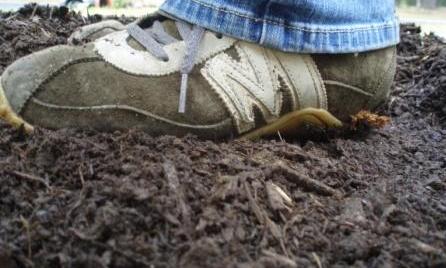
Our gardens love the rain! But be careful, wet soil is more vulnerable to compaction, especially clayey soils. The physical damage from compaction can
  • increase bulk density, where soil pores are now too small to accommodate the root cap's growth
  • increase soil's ability to resist deformation (soil strength), and prevent root penetration.
  • crushes natural soil aggregates and associated macropores, thereby preventing adequate water and air flow.
All this means reduced root growth and therefore less overall vigor of a plant, from your garden plants to large trees! Clay soils are more vulnerable to having their structure damaged due to their increased plasticity and cohesion. Try not to walk too much on your wet soils; perhaps make a permanent path in your garden to help you remember.

Here are some definitions:

Bulk density: weight per volume of soil
Soil Strength: ability of a soil to resist deformation (change in shape)
Plasticity: ability of a soil to be molded or deformed by pressure
Cohesion: stick/stay together
Soil aggregates: soil particles that are held together in one mass
Macropores: soil pores large enough to allow for air and water flow, and even some small animals (some animals make macropores!)
(reference)