Pine needles were recently thrust into my consciousness by
two friends. So, if you don't mind, let's discuss the skinny on pine needles, shall we?
But before we delve, side note! I did learn one consideration in its sustainability of use during my internet perusing. Harvesting pine needles off the ground, like harvesting any other crop, ultimately reduces the nutrients in the soil, so conscientious pine needle collectors may want to give something back for the taking.
Moving on, did you know how awesome they are? They are a pretty good mulch!
Look at all these reasons! Particularly on hillsides, since they interconnect with each other and stay put. But many people believe that pine needles, as mulch, add acidity. Perhaps they read
this link (look under wheat straw). But what if you didn't think it was acidic at all, because you read
this link? Or what if you were like, who cares, I read this
pine needle apologist! So I asked the expert who wrote
this, where he originally writes that pine needles should be put on acid-loving plants. He is Dr.
Don Rakow, Executive director of
Cornell Plantations at Cornell. He explained his text succinctly:
Pine needles have been shown to be slightly acidic, usually in the range of pH 6.0 – 6.5. This is not very different from average rainfall pH. The acidity is related to the presence of hydrogen ions in the volatile terpenes in the needles. For a review of a somewhat rigorous series of experiments that examined this subject, check out: Pine Straw (Pine Needle) Mulch Acidity: Separating Fact From Fiction Through Analytical Testing by Scott Jacobs.
So there you have it, it is acidic, but only temporarily and not enough to worry about. So all the supposedly conflicting information from reliable sources out there, were all right in their own way. So I guess this is another
YES WE CAN, agree moment, heee.
By the way, you may be curious about terpenes. They are "compounds produced by plants from isoprene, a hydrocarbon that has its five carbon atoms arranged in a branched chain." They smell really good, and in the leaves of a conifer tree suffering from air pollution, they change in chemical composition and amount (more evocative terpene-talk
here, from where I got this info). Wow.
Pine needles by any other name would still smell like terpenes.
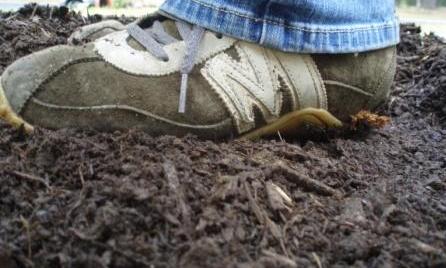
(P.S. One day I'll read the instruction manual on my camera, and maybe get a better pic for you)
(P.P.S. Speaking of soil myths and mulch,
here are some interesting tidbits on mulch selection from an Australian soil blogger)