Thursday, August 26, 2010

11 things you can do to increase water in Austin creeks

This creek has high water flow during rain events; you can see the big pile of brush that the water carried.  But a day later,  it is sunny and the creek is dry (Fort Branch Watershed at Springdale Rd., I think).
We talked earlier about how one of the problems in local Austin streams is that they have too much water when it rains [which renders our poor froggies and fish practically habitat-less from all that turbulence], but not enough the rest of the time.  This, in part, is caused by how we have developed impermeable cover on top of our soil.  Basically, we've become urban.  For more details, please read my post on Watersheds in a nutshell in a nutshell.  Thanks!  Now onto the proactivity...

There are ways we can help those little froggies and fish keep their homes, and it doesn't have to be done by big groups of people.  Each yard can make a difference!  All we have to do is point water in a new direction, away from runoff and evaporation, and towards infiltration into the soil and groundwater.  When water is supplied to creeks by  groundwater recharge instead of runoff, creeks flow at a more constant rate.  A more constant flow rate helps preserve aquatic habitat.

Below are some tips directly from the City of Austin's Watershed Protection Department and the EPA that will help our creeks flow.

Structural improvements:

Plants:
  • Select yard plants that have low requirements for water.
  • Preserve existing trees, and plant trees and shrubs.
  • Irrigate efficiently to avoid runoff from your yard (source).  For example, using "slow-watering techniques such as trickle irrigation or soaker hoses reduce runoff and are 20 percent more effective than sprinklers." (Thanks, EPA!)
Ground cover:
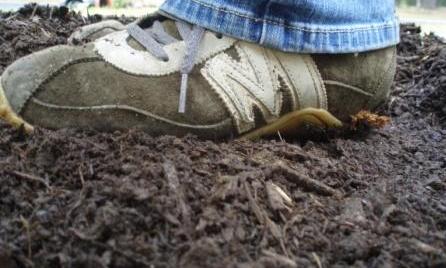
  • Spread mulch on bare ground or restore bare patches in your lawn.
  • Use compost. Compost retains moisture in the soil and thus helps you conserve water.

Increasing vegetation and ground covers are doubly effective.  They increase infiltration, and they also reduce evaporation!  Increased evaporation from impermeable ground surface is an often forgotten result of the increased urbanization of our watersheds.  By increasing shade, and thereby decreasing heat, we reduce evaporation (click here for more physic-sy evaporation details and terminology, just scroll down on the right side and look for terms).  This way, the water stays longer right where we want it, it our watershed!

What about you?  Do you have other tips?  This is Austin, so we can be creative!

***UPDATE!!!***

Here is a 12th, amazing extra credit thing you can do: Create a green roof!  Thanks for the idea, Wildflower Center!

Tuesday, August 17, 2010

It was hot today: the dirt on the heat index.

Fer reals.  The National Weather Service predicted that it would feel like 110°F (Fahrenheit) today.  Same for tomorrow, I hear.  This does not bode well for the following polar bear:
Maryland: Where men are almost as tall as mountains.
What are they saying when they predict it will feel like 110°F, even if it is only [only: ha!] 102°F?  They are talking about the Heat Index.  At first I thought it was the same as the term "effective temperature".  Oh, but no; when I looked up that definition, I got this from Columbia University: 
The effective temperature of a planet is the temperature it would have if it acted like a black body, absorbing all the incoming radiation received at its surface and reradiating it all back to space.
That's not what I want! This is what I was looking for, from NOAA's National Weather Service:
The Heat Index (HI) or the "Apparent Temperature" is an accurate measure of how hot it really feels when the Relative Humidity (RH) is added to the actual air temperature.
Please click on their link for all the details, it is pretty good text, but in the mean time, here is my favorite part:
The body's blood is circulated closer to the skin's surface, and excess heat drains off into the cooler atmosphere by one or a combination of three ways...
  • radiation,
  • convection, and
  • evaporation.
At lower temperatures, radiation and convection are efficient methods of removing heat. However, once the air temperature reaches 95°F (35°C), heat loss by radiation and convection ceases. It is at this point that heat loss by sweating becomes all-important. But sweating, by itself, does nothing to cool the body, unless the water is removed by evaporation (sweat changing to water vapor). The downside of this method of cooling is that high relative humidity retards evaporation.  (reference link)


Considering their explanation, I'm surprised that wind speed isn't factored into it.   Doesn't wind promote evaporation?  Cuzzzzzz it blows the humidity away?  


But here is a funny thing part: the heat index was first introduced by R.G. Steadman (1979) in his document called  "The Assessment of Sultriness, Parts 1 and 2." 


Sultriness. Hee!

Sunday, August 15, 2010

Definitions are funny

I wanted to talk about the difference between soil and rocks, but when I started looking up definitions, I remembered that there isn't a singular definition on which we all agree for these things.  The definition of a word depends on who you talk to, and the definitions bleed into one another.  

Geology
For example, I happened upon the knowledge that the classic definition of geology is the study of the earth


The study. 
Of the earth.  (Doesn't that kinda mean everything? Doesn't the study of the earth also mean economics and anthropology and religion?)
And its life forms, and the evolution of life.  
Which now sounds more like biology.  


To be honest, I like this definition.  Cuz I think that geology does include the study life and its evolution (for example, paleontology), but only as it has been recorded in the rock record.  But what are rocks?


Rock
Please click here for the definition of "rock, " courtesy of the US Geological Survey (USGS).  Notice they use the word "mineral."  What are those?

Mineral
Please read the definition "mineral,"  by the Soil Science Society of America (SSSA)- "a naturally occurring homogeneous solid, inorganically formed, with a definite chemical composition and an ordered atomic arrangement."  

Oh, but no! The USGS begs to differ.  They are more specific than the SSSA's "homogeneous solid," calling it an element or compound instead.  I like this better.  Also, "the ordered atomic arrangement" is called a "crystal form" by the USGS.   Same difference.

I know.  Tedious.


Soil
Anyways, here are soil definitions, courtesy of the NRCS.

Here is some mica.  Common in the Glenelg silt loam in Maryland.  Use fingerprints for scale.
What I get, is that soil has rocks in it, but soil is also an ecosystem.  There is air, liquids, and solids in soil.  There is water, there are minerals.  There is representation from all taxonomic kingdoms of life.  Oh and look, there is also my heart and soul (transcendent violins, please! And an angelic chorus).  

Wednesday, August 11, 2010

How to get in on tonight's Perseid meteor shower.

Did you know that tonight (Texas Standard Time) is the best time to watch the Perseid "shooting stars"?  They come around every August.  I have some great memories of watching them with many a BFF.  So fun.  The good news is that, even A-town's night-light pollution won't block out the brightest comets in this meteor shower!  Of course, according to Bill Cooke of NASA's Meteoroid Environment Office at the Marshall Space Flight Center, the best show will be away from city lights.  "The greater flurry of faint, delicate meteors is visible only from the countryside," he says.

Here is a pic from the same webpage.  Imagine lots of these at once [well you know, within an hour]! Weee!

Further details lifted from NASA:
Peak Activity: Aug. 12-13, 2010, approximately 50 meteors per hour. The crescent moon will set early in the evening, allowing for dark skies all the way up until peak viewing just before dawn.  Meteor Velocity: 61 kilometers (38 miles) per second.   
Note: The Perseid meteor shower is one of the most consistent performers and considered by many as 2010's best shower. The meteors they produce are among the brightest of all meteor showers. 
What is the Perseid meteor shower? I lifted this next info from the Discovery magazine  blog.
WHAT: The height of the Perseid shower comes every August, because that’s the time our planet passes through a certain debris path.
The Perseids are created by the tiny remnants left behind by comet Swift-Tuttle. The Earth passes through this material once a year, creating a spectacular show as the cometary particles burn up in the atmosphere.
 So,  in the spirit of pondering that which is greater than us, here is a youtube link.


More links:

Wednesday, July 28, 2010

Vertisols, veritably difficult.

Once upon a time, I took a class on tropical soil management (SOS 5132) by Dr. Hugh Popenoe, at the University of Florida.  Each day, we would get a slide show of pictures from farms all over the world that highlighted low-input agriculture.   It wasn't my typical technical science class; we learned from stories.  This post is on one of the many cool things I learned. 
I got this photo from here
According to the USDA-NRCS, vertisols are high shrink/swell content clays that have deep wide cracks in the dry season. They shrink (to the point of cracking) when drying and swell when absorbing moisture.  Also according to the USDA-NRCS, I live on a classic vertisol, the Houston Black Clay (associated sob story and fun fact).  The state soil of Texas.

According to my class notes, vertisols typically have a wavy, bumpy surface due to all of their shrinking and swelling.  They are usually dark brown, and are located on flat or low slope soils.  Although they have a high exchange capacity (ability to hold nutrients), their massive* structure makes it easy to erode.  


The shrinking and swelling can damage roots, and the soil is hard to plow unless it has just the right soil  moisture (what that magic number is, I can't tell you, it's magic).  If you plow it when it is too wet, you will be creating clods that harden as they dry, almost to the strength of  rocks.  


So how can you manage it? The notes say two things: 1) "Well, annuals, pasture and rice do best on the soil."  This makes sense to me since my soil developed with prairie vegetation from a parent material of calcareous clays and marls  2) "You must manage soil moisture, and cultivate at right moisture content."  


I have a third tip.  If you build a house on it, enjoy the options of either watching grass grow or the cracks on your wall grow**!!  They are about the same :-l

By the way, remember my post on the five soil forming factors?  Well, vertisols and alfisols (a better drained soil order) are both found in same climactic zone, with the same type parent material, but different topography. They both developed from and found on basic parent materials like andecite, limestone, and basalt.

Links for further study:
*massive in this case means structureless
** from your house foundation shifting

Sunday, July 18, 2010

Plants care about soil pH

Fact: Soil pH* affects the availability of nutrients for plants.

Here is a figure that shows the relationship of soil pH with nutrient availability to plants.  The thicker the color, the greater the availability of that nutrient to the plant.  For the most part, plants can get the most nutrition at pH values between 6-7.
Question: Why?
Answer: Well, one could write a book on this, a looooooong book, but this is a blog post, so let us settle with the main idea...supply and demand!

For the most part, soil has a negative charge.  Negative charges attract positive charges (or cations*).  Hydrogen has a positive charge...

  • ...and when there is  a lot of positively charged hydrogen (i.e., less basic, lower pH), there is more of it available to bind to the negatively charged soil.  When more hydrogen is bonded to the soil, there is less of a chance for other positively charged nutrients to bind to the soil.  Without binding to the soil, they have a chance to nourish the plant, but they are also more easily leached away (like when it rains).
  • ...and when there is less hydrogen (i.e., more basic, high pH), there is less of it available to bind to the soil.  When less hydrogen is bonded to the soil, there is more of a chance for other positively charged nutrients to bind to the soil instead of being allowed to nourish the plant. (Link to reference)
More learning resources:
In case you ever found yourself in front of a classroom of middle schoolers, and all you had were test tubes, plugs, scoops, pipettes, graduated cylinders, universal indicator solution, beakers, three different soil types, a stop watch, a color chart pH scale, and nothing to talk about, I propose this lesson plan for you: Measuring pH in soil.  I found this at the University of Texas Environmental Science Institute.  It also has other learning resources for teachers and students.

Also,  I found a webpage with great links to nutrient management teaching modules.  Although they might be easier to read if you have some science background, I am still impressed with their clarity.

*Definiciones:

Soil pH: a measure of the soil’s acidity, or hydrogen (H+) concentration.  
pH = -log[H+], 
where [H+] = the hydrogen ion concentration. 
Because of the negative sign in the definition for pH, low pH soils have more hydrogen than high pH soils.  
Acidic soil: a soil with pH values <7 (high hydrogen concentration)
Alkaline soil: a soil with pH >7 (low hydrogen concentration)
Cations: We defined cations here.  They are ions that carry a positive charge of electricity.
Cation Exchange Capacity: the total negative charge on soil, which is a good measure of the ability of a soil to retain and supply nutrients to a crop.

Friday, July 9, 2010

As the soil turns.

Hello dear readers! I went on a quick trip to Swallow Falls State Park in Maryland.  Swimming in the waterfall was so much fun!  I took a few pictures as I thought about the difference between rocks and soil.

There are 5 factors that work together to form soil:
  1. Parent material - It can be mineral and/or organic (i.e. decomposing plants).
  2. Climate -  Different environmental factors (i.e. temperature and precipitation) affect chemical and physical weathering
  3. Living organisms - Among other things, they help organic matter biodegrade, and can mix soil layers/horizons into each other.  Their chemical reactions can cause chemical weathering.
  4. Topography - For example, valleys accumulate soil and water, hilltops shed them.  This affects the type of soil created. 
  5. Time - Neat factoid: sometimes a very chronologically old soil won't be very developed, and vice versa.
For more, there are quick explanations at NASA and the NRCS.


The Soil Science Society of America gives us a two part definition of soil. This is the first part: 
 "The unconsolidated mineral or organic material on the immediate surface of the Earth that serves as a natural medium for the growth of land plants."
Below, I'm sharing with you my pictorial exploration of a plant's contribution to soil development.

Plant pioneers.  This guy might trap tiny rock fragments or organic debris which will grow his soil pile.  To be honest though, erosion is high here.  It was on a slope.  This soil might not develop further.

These guys have a small part in a very big process.  I imagine their roots will help make this crack a little bigger, making it able to hold even more soil, allowing even bigger plants to grow here in the future.

Growing sideways out of a crack between two rock layers.  Not much opportunity for soil development here, but don't tell her!

This shrub (tree?) has chutzpah.  It looks like it is growing out of the rock.

It looks like these guys are the furthest along in helping to develop soil, but they still have a looooong way to go!  When these plants die, they will contribute organic matter to the soil for new plants.  

Even if these little bits of soil are chronological Methuselahs, environmental factors prevent them from developing horizons.  Mayhaps erosion rates are faster than the rate of soil development.  If so, the soil would be characterized as an Entisol.  Entisols are the youngest (meaning least developed) of the 12 soil orders. 


And let's end on a lithologic music note...