Saturday, April 9, 2011

Update: Buried Seeds Turn Into Plants!

Hello, everyone!  Long time no read and write!  I've missed you.  Lots of things have happened since we last e-spoke, but not much soil-oriented stuff.  Let's catch up?

Last year on October 31rst, 2010, many of us celebrated The Halloween.  Many of us bought, if not grew, a pumpkin.  I bet you even composted it!  My readers are so responsible.  And then there is yours truly, a different kind of responsible...I thought I'd keep my uncut pumpkin as front door decoration until it started to spoil.  Almost 5 months pass by and the loyal little pumpkin, exposed to the ATX elements, gets passed by us every day as we walk through our house entrance.  Enter MARCH 2011! The little pumpkin that could, gave up.  Ew.  Stinky.

Lazy, I contract my son to help me chop up the gooey mess and bury it in place.  Cuz, like, the compost bin is ALL THE WAY around my house, IN THE BACKYARD, so far away!!!!

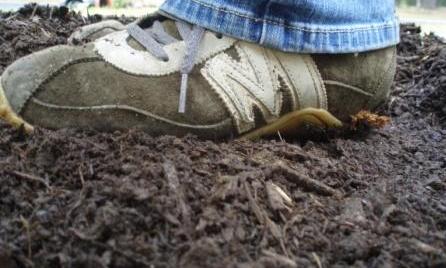
And then...a week later.  A little biology reminder.


I feel like I'm at the very beginning of the Neolithic Revolution.
What I find most fun about this li'l situation, is that it is as if the pumpkin knew when to rot- it is the beginning (and almost the end) of pumpkin planting season in Travis County!

In other news, my son thanked me the other day, out of the blue.
I said, "For what?"
"For trees," he said.
I guess he was talking to his other mom (ahem, Mother Nature).

Thursday, March 31, 2011

Hello Sandbox, my old friend

Hello Dear Readers!
How are you today? How is your sun shining?  We're having nice, crisp cool weather here.  Oh, by the way-

Happy Sandbox Appreciation Day!  

Remember that one time (at band camp), when I referred to Sand as boring?  Wasn't that ignorant and rude!?  With a spirit of atonement and reconciliation, I declare today Sandbox Appreciation Day (I can do this because, who is stopping me?).

Dear Sandbox,
New sandbox courtesy of the very civic Hubs.

You are a pretty cheap way of introducing science and engineering to youngsters of all kinds and abilities (and their reminiscent parents).  You are super fun.  I remember playing in you for hours and hours under the grateful eye of The Parents (cuz I was quietly and productively occupied without their effort, heh.  Love you!).
Hours add up to days and weeks of scientific inquiry.  Who knows how long I played in there-  my concept of time has evolved.

And now I realize how much I learned from you.  Days spent with you, Sandbox, were my first physics lessons.

What did I learn? How to build, in my minds eye, buildings, mountains, rivers, dams, lakes, canals, pits and moats and other natural and man-made wonders. That you have a sweet spot, a preferred soil moisture for forming stable shapes with molds, and reducing your stickiness to the molding buckets.

You subconsciously led my life interest to the earth sciences.  You may have led others to NASA.  And you are pretty fun.  Thank you Sandbox, and thank you Hubs for making one for The Kiddo.

Dear Sandbox, 
Big Hugs,
The Dirt on soil

Wednesday, March 2, 2011

Ask an expert that isn't me

Ever want an answer to your question from a person, and not The Google?  You know, cuz books are so passé?  With these links, you can get the personalized soil attention we all crave:
  • Ask a soil expert from the Professional Soil Scientists Society of Texas, or
  • Ask a native plant expert from the Lady Bird JohnsonWildflower Center (University of Texas), or
  • Ask an extension agent, fluent in all types of natural resources from Texas Agrilife Extension (Texas A&M University).
These pages will also find you someone to answer your deep, dark, fertile questions on the world around you.  Yay!


Monday, January 17, 2011

What is Science?

Science isn't being bored in class while someone lectures.
Science is the learning we gain through the scientific method.


Observation Hey, look!
Question Why is it like this?
Hypothesis Well one time, at band camp, this happened, so maybe ...
Prediction it would happen the same way here.
Testing No.  Hmm.  Wonder why.  Let's try this.

And that is all in the way of learning you will get from me today.  But you wanna see something cool (Doyle, did you post about this?  I forget where I first saw it, but THANKS to who did!)?  Look at this.
Wanna read something cool? Read how they did it.

Can you imagine how much sky-watching and tinkering they'd have to do before they'd come up with that system? Quite obviously, for at least a few people, staring out into space (and actually paying attention) was the thing to do.  Sweet.

And then there is this:
And thanks to Classic Detritus, we get beautiful art, with an explanation of some of it's scientific limitations.
 In a nutshell, in "real life," the shell they have in the movie dons't match the math they are showing.  It is still a logarithmic spiral though.  But I can't confirm, I didn't do the measurements myself.

And of course, there is one of the reasons I wrote this whole post: I found some awesome shells on Galveston Beach on New Year's Day (To my hubs, these shells seemed much more fragile this year than he remembers.  Of course, his hands don't count as a scientific instrument.  We'd need something with more accuracy and precision.  But it got us thinking.  What would make them more fragile?  What happened between last year and this one?  The BP oil spill happened.  What was that dispersant again? But maybe these are just older, more worn shells than the ones you've crushed before?  No, he says.  Well, we know CO2 makes water more acidic.  And an increase of CO2 in the atmosphere would influence the dissolved CO2 in the ocean.  And acidity "eats away" at calcium carbonate.  And if they are made of calcium carbonate...but we don't know.  We weren't using the scientific method all the way through, you see?  No testing, no researching through peer review journal articles.  But observation, paying attention, and wondering and being curious will get you pretty far, but the tedious tinkering of the dedicated and hardworking may save us all.)

You see, science is everywhere.  All we have to do is pay attention.


All I got so far in my new room.  Don't judge.  We can go from here to the scientific method, no probs.
P.S. The way that my tutor groups are divided, I only get the same kids 9 times before my gig is up.  I got 9 80-minute sessions to inspire them to consider that Science is the way, the truth, and the life, and that they should never be discouraged from challenging themselves with it's study.  No pressure, right?  Send advice, now please, thanks.

Wednesday, January 12, 2011

Bad Mother Earth Daughter

Ooooh, I've been a bad Mother Earth Daughter!  Please Mom, allow me to apologize! But first, let us look at what seems to be the new theme of my blog: illegal yet agronomic art.  Let us pause to say
Dearest vandals and/or artists,
I do not support your allegedly illegal acts, oh no! I do however, like your topics of interest.  Please pursue them constructively.  Mayhaps my Introduction to Environmental Science class at ACC would interest you next semester.  You may learn that there are VOCs in them thar spray paints, and there are health risks involved in exposing yourself to them, and then perhaps you would choose to use milk-based paints. Legally.  Heh.
 Thank you.  
Love, TheDirtOnSoil
PS Sorry for the commersh milk link, I'm not getting paid to link to it.  But you and Martha Stewart do have something in common!!! And it is a recipe, so- Awesome!
You see? It is hard not to admire the topic.

Back to why I am not on Mother Earth's Good List right now:
The basil seeds will replant themselves, no problem! 
  1. I am on a compost break.
  2. My pet soldier flies disappeared (I think I can blame the cold, at least in part. But you know the whole not-giving-them-food thing has got to be causing problems.).
  3. I haven't been prosthelytizing about soil to my full potential: educational blog post frequency = decreasing.
  4. My garden... you know, has been neglected.
Maybe a few minutes of your time, Amanda?
Yet there is hope for me, fellow souls.  There is yet hope.  For example,
  1. Prosthelytizing will increase next week when I start tutoring science to high school kids and professoring environmental science to college kids.  
  2. Also, I did take the Soil Science licensing exam.  I didn't say I passed it. That is to be determined.  
  3. I've been planning an awesome post *since September cough cough cough* on how urine is chemically transformed to plant food (AKA nitrate) by bacteria.  You didn't think it happened all by itself did you?  It might be free fertilizer to us, but those nitrosomonas and nitrobacter gotta work for their money.  So you know, please keep the faith and stay tuned.
Wait, what is my point?  Oh that is right, I didn't have one.  Blogging is fun!! 
Thank you Parsley, for not making it look so bad.  You look great.  Keep it up.

Sunday, January 9, 2011

Math Science Photo Series

Found this art on the Speedway Grocery at the corner of Speedway and 38th in ATX.  BTW, if you are a very strict parent, don't take your adorable toddler in there because the nice people inside will offer him/her free candy (I guess not everyone is immune to his smile)!  But if you are very strict, said toddler will freak out with chocolate glee.


Tuesday, January 4, 2011

See Roots in their Natural Habitat

Dearest soil enthusiasts,


¡Feliz año nuevo!  ¿Cómo fue su celebración?

To celebrate my new science teaching jobs that I mentioned on Twitter, I'm looking around for fun soil science ideas that address our Texas HS Science learning objectives, TEKS.  I found instructions for making a root viewing box where you can make lots of fun experiments.   I hope I can muster up the motor skills to make one.  Hammer, please avoid my fingers.  Thank you.  I found instructions here (horizontally oriented) and here (vertically oriented).  Mickey over at My Wisconsin Garden made a pretty one with cedar with some nice germination results.
Vertically oriented root viewing box by the NRCS
Of course, we can use root viewing boxes to learn about tropism*, like
  • positive geotropism (grow towards the source of gravity), and 
  • negative light tropism (grow away form the source of light), and 
  • negative thigmatropism (growing away from obstacles touching them)  (activity details for all here)
You could
  • see how the roots respond to different soil textures (sand, silt, and clay), and
  • varying soil moisture at depth (water it for longer or shorter time periods)
You could
  • compare the root lengths of different plants, like native Texan prairie grass to conventional lawn grasses, and then 
  • think about what that means for facilitating erosion (Native is better! But find out for yourself).  
You could
  • do so many things!  Heh, you though you were getting more, eh?
Also, the Capital Area Master Naturalist's Education and Outreach Committee has a learning activity on root length, and you can ask them to present it to your group.  Any age.
    If I make this you'll soooo get pictures, hopefully in a classroom setting, administration-willing.


    HUGS.


    *Definiciones:
    Tropism: A response to stimuli by plants is called a tropism (source).