Saturday, March 27, 2010

"What is your soil?" is the new "What is your sign?"

Vertisol at the playground.  8-foot baby used for scale.  See the shrink/swell cracks?
I'm a Taurus, and I love asking people this question.  But more and more, instead of looking at the stars, I'm going to look you up via the ab-fab NRCS Web Soil Survey (WSS) to see what kind of soil you have.  


For example, I proudly (and digruntled-ly, given its issues with construction and amateur gardening) live on the state soil of Texas, the Houston Black clay, a Fine, montmorillonitic, thermic Udic Haplustert.  The "ert" in Haplustert means it is a vertisol- a shrink-swell clay (we've discussed the joys of this before).


Ultisol Analysis!
Anyways, my friend and fellow soil-o-phile over at the Bipartisan Victory Garden lives in Florida, and on the (drum roll please) Millhopper-​Urban land complex, 0 to 5 percent slopes! Ooooooh!  What does this mean for her?  Let us consult the WSS, shall we?


This series is a Loamy, siliceous, semiactive, hyperthermic Grossarenic Paleudult.  The "ults" in Paleudults means it belongs in the soil order Ultisol. Booooohhhhh.  Very sad.  Why? Ultisols are naturally low-nutrient soils.  Not only are there not many nutrients, it has a low cation exchange capacity (!), which means even if you add nutrients, the soil will have a hard time storing them.  However, there is a lot of good news.  Especially considering the woman on this soil- she can pay attention, and this soil responds well to good management.  Here is the good news-

  • these soils are formed in areas with long growing seasons and plenty of water (this is where the "ud" in Paleudult comes from: humidity),
  • the silicate clays in ultisols are usually not sticky (unlike my lovely smectite vertisol, sigh), meaning they are pretty workable,
  • with lime (to counteract the soil's acidity) and proper fertilization (and compost, mayhaps?), this soil competes with the breadbasket mollisols and alfisols we all pine after ;-) HOWEVER, liming an ultisol to >6.5 pH can reduce phosphorus and micronutrient availability.  Why? Not sure yet.  It has something to do with precipitation of Ca or Mg phosphates.

Más definiciones:

Hyperthermic: >22 degrees Celsius average annual temperature
Thermic: 15-22 degrees Celsius average annual temperature
Ultisol: soils with low base saturation (<35%) and an argillic or kandic horizon (translocated silicate clay) or fragipan. Base saturation decreases with depth (reference).
Vertisol: Soil with 30% or more clay and that shrinks when dry (and cracks) and swells when wet.

Friday, March 26, 2010

Why you need enough Nitrogen in your compost

This bird bath needs compost.
A major source of locally derived soluble nitrogen (N) for your plants is...the bacteria that eat your compost!   They live at a certain ratio of C:N (carbon to nitrogen).  Since there is usully enough C in the environment, these guys are usually hunting for N.  And if they can't find enough N in the environment around them (say, your compost bin), then they can't grow. So if your compost does not have enough N (too much C) , it won't break down very quickly.  But here is where your garden comes in- if you put fresh compost onto your soil that hasn't completely broken down, and there is not enough N in the compost for the bacteria to grow, then the bacteria will compete with your plants for the N in the soil water solution- no bueno!

Sources of nitrogen for your compost:
  • coffee grounds (just like manure, don't add directly to plants before composting!)
  • animal manure (make sure this cures, there could be disease)  
  • any more ideas?
This looks like a good place to add some Nitrogen!
If you don't have coffee grounds or animal manure, don't worry.  Most mature household compost has plenty of nitrogen (a ratio of 15:1 versus the maximum 25:1 ratio).  Just make sure you don't input too much "dry" stuff to your compost, such as dried up grass or leaves.  For example, sawdust, straw, and newspaper has WAY too much carbon to compost on its own.

Friday, March 12, 2010

Compost teaser

Indeed, my compost smells like roses.
A commenter recently asked how to get started on compost.  I haven't gathered all the necessary information yet, but I wanted to give you a quick factoid to get you interested. The time that it takes to transform your compost into usable nutrients for your plants can vary from days to years, depending on environmental conditions and contents of your compost.  The fastest way to get nutritive use from your compost  (there are other uses!) is to create the following conditions:

  • temperatures between 77 and 95 degrees Fahrenheit (25-35 degrees Celsius),
  • a pH close to neutral,
  • good soil moisture(within your volume of soil, about 60% of the void space is filled with water instead of air), AND
  • good aeration (reference).

Friday, March 5, 2010

Gardening on the Limestone rock land-Lozier association

A friend of mine lives on this soil association. What type of soil is this? It is pretty much just solid rock! My favorite quotation about this soil, from the archived El Paso County soil survey is this:

These very shallow soils have a surface layer of pinkish-gray, calcareous, moderately alkaline stony loam that is about 5 inches thick over limestone. All of this association is used as rangeland or for wildlife or recreation. Hueco Tanks Park, a recreational and historic site, is on the association.

I can't find the soil genetic line right now (a.k.a. it's proper name starting at the order level)

My first thoughts: There is no soil to garden here. Anyone trying to improve the soil for gardening is in it for the long-term ;-) So to grow any non-native plants, you'd essentially be container gardening. Bring in yer soil;  maintain moisture content with compost/organic matter; strategic water supply; protect with shade; use that humanure you bragged about.

What will your humanure do to this soil if incorporated long-term? Will its acidity help breakdown that limestone rock?  Hmmm....

Any other suggestions, other than head on over to the grocery store?

Saturday, February 27, 2010

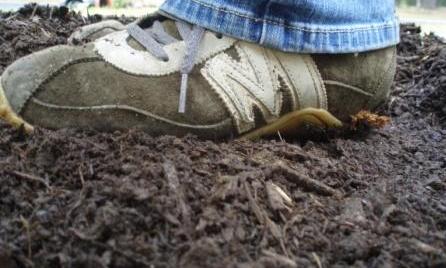
Why you wait to walk on wet soil

Our gardens love the rain! But be careful, wet soil is more vulnerable to compaction, especially clayey soils. The physical damage from compaction can
  • increase bulk density, where soil pores are now too small to accommodate the root cap's growth
  • increase soil's ability to resist deformation (soil strength), and prevent root penetration.
  • crushes natural soil aggregates and associated macropores, thereby preventing adequate water and air flow.
All this means reduced root growth and therefore less overall vigor of a plant, from your garden plants to large trees! Clay soils are more vulnerable to having their structure damaged due to their increased plasticity and cohesion. Try not to walk too much on your wet soils; perhaps make a permanent path in your garden to help you remember.

Here are some definitions:

Bulk density: weight per volume of soil
Soil Strength: ability of a soil to resist deformation (change in shape)
Plasticity: ability of a soil to be molded or deformed by pressure
Cohesion: stick/stay together
Soil aggregates: soil particles that are held together in one mass
Macropores: soil pores large enough to allow for air and water flow, and even some small animals (some animals make macropores!)
(reference)

Sunday, February 21, 2010

Enjoying the Archived PDF County Soil Survey


If you are someone who likes to read paper more than a screen, you may consider using the Archived PDFs of the County Soil Surveys instead of the online web soil survey.

From the archived Travis County survey, I found out that the soil under our house is part of the Blackland Prairie Texas ecosystem. We live on the Houston Black series, which is the state soil of Texas. Its usefulness in crop production is mentioned, and it also warns that its shrink-swell capabilities ... well, let me just quote it.
"The main limitations in use of the soils of this association in urbanization are the shrink-swell characteristics, as they affect foundations and streets; corrosivity, as it affects pipelines and cables; and the poor suitability of the soils for septic systems."
Our whole street is on this soil, and many of us are having foundation issues, and pipeline issues. The corrosivity that the survey mentions is showing up on our own rusted pipes.

Why is it corrosive? Is it more than just the high water holding capacity? Interesting...

Anyways, if there is anything for which you'd like to use your soil, you'll find it here in these soil surveys. Awesome!

Monday, February 15, 2010

When clay soil and cast iron pipes meet


My house is among the many houses built in East Austin in the late 1950s (and maybe other places) that used a unique type of iron pipes for the sewer pipes leading from the house to the city sewer mains in the street. Typically houses are built with cast iron pipes, but this iron was centrifugally spun to create the hole in the center instead of in a cast (info courtesy of our plumber). Somehow this makes them more vulnerable (not sure of the details). Anyways, over time, the chemicals we pour down our drain can damage any iron pipes. Also, in the case of our house, if you don't have enough slope in your pipes, standing water can them rust away. It is possible that over time, corrosion of your pipes will accumulate such that you get a hole in your pipe, and instead of waste water being delivered to your city sewer system, you are also watering the ground underneath your house with chemicals (shampoo, household cleaners etc.) and other gross human goo. Another reason these pipes may be seeing their last days is that they reside in clay soil. Clay soil retains water very well, and we all know what happens when you mix water and iron: rust! Anyways, it is 2010 and this is a picture of the pipes that are now being excavated from our soil not a moment too soon.