Wednesday, July 28, 2010

Vertisols, veritably difficult.

Once upon a time, I took a class on tropical soil management (SOS 5132) by Dr. Hugh Popenoe, at the University of Florida.  Each day, we would get a slide show of pictures from farms all over the world that highlighted low-input agriculture.   It wasn't my typical technical science class; we learned from stories.  This post is on one of the many cool things I learned. 
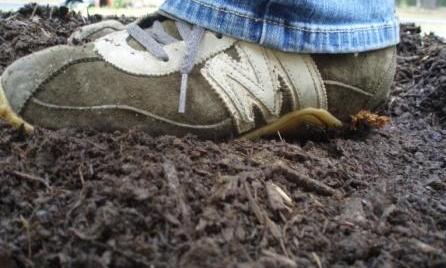
I got this photo from here
According to the USDA-NRCS, vertisols are high shrink/swell content clays that have deep wide cracks in the dry season. They shrink (to the point of cracking) when drying and swell when absorbing moisture.  Also according to the USDA-NRCS, I live on a classic vertisol, the Houston Black Clay (associated sob story and fun fact).  The state soil of Texas.

According to my class notes, vertisols typically have a wavy, bumpy surface due to all of their shrinking and swelling.  They are usually dark brown, and are located on flat or low slope soils.  Although they have a high exchange capacity (ability to hold nutrients), their massive* structure makes it easy to erode.  


The shrinking and swelling can damage roots, and the soil is hard to plow unless it has just the right soil  moisture (what that magic number is, I can't tell you, it's magic).  If you plow it when it is too wet, you will be creating clods that harden as they dry, almost to the strength of  rocks.  


So how can you manage it? The notes say two things: 1) "Well, annuals, pasture and rice do best on the soil."  This makes sense to me since my soil developed with prairie vegetation from a parent material of calcareous clays and marls  2) "You must manage soil moisture, and cultivate at right moisture content."  


I have a third tip.  If you build a house on it, enjoy the options of either watching grass grow or the cracks on your wall grow**!!  They are about the same :-l

By the way, remember my post on the five soil forming factors?  Well, vertisols and alfisols (a better drained soil order) are both found in same climactic zone, with the same type parent material, but different topography. They both developed from and found on basic parent materials like andecite, limestone, and basalt.

Links for further study:
*massive in this case means structureless
** from your house foundation shifting

Sunday, July 18, 2010

Plants care about soil pH

Fact: Soil pH* affects the availability of nutrients for plants.

Here is a figure that shows the relationship of soil pH with nutrient availability to plants.  The thicker the color, the greater the availability of that nutrient to the plant.  For the most part, plants can get the most nutrition at pH values between 6-7.
Question: Why?
Answer: Well, one could write a book on this, a looooooong book, but this is a blog post, so let us settle with the main idea...supply and demand!

For the most part, soil has a negative charge.  Negative charges attract positive charges (or cations*).  Hydrogen has a positive charge...

  • ...and when there is  a lot of positively charged hydrogen (i.e., less basic, lower pH), there is more of it available to bind to the negatively charged soil.  When more hydrogen is bonded to the soil, there is less of a chance for other positively charged nutrients to bind to the soil.  Without binding to the soil, they have a chance to nourish the plant, but they are also more easily leached away (like when it rains).
  • ...and when there is less hydrogen (i.e., more basic, high pH), there is less of it available to bind to the soil.  When less hydrogen is bonded to the soil, there is more of a chance for other positively charged nutrients to bind to the soil instead of being allowed to nourish the plant. (Link to reference)
More learning resources:
In case you ever found yourself in front of a classroom of middle schoolers, and all you had were test tubes, plugs, scoops, pipettes, graduated cylinders, universal indicator solution, beakers, three different soil types, a stop watch, a color chart pH scale, and nothing to talk about, I propose this lesson plan for you: Measuring pH in soil.  I found this at the University of Texas Environmental Science Institute.  It also has other learning resources for teachers and students.

Also,  I found a webpage with great links to nutrient management teaching modules.  Although they might be easier to read if you have some science background, I am still impressed with their clarity.

*Definiciones:

Soil pH: a measure of the soil’s acidity, or hydrogen (H+) concentration.  
pH = -log[H+], 
where [H+] = the hydrogen ion concentration. 
Because of the negative sign in the definition for pH, low pH soils have more hydrogen than high pH soils.  
Acidic soil: a soil with pH values <7 (high hydrogen concentration)
Alkaline soil: a soil with pH >7 (low hydrogen concentration)
Cations: We defined cations here.  They are ions that carry a positive charge of electricity.
Cation Exchange Capacity: the total negative charge on soil, which is a good measure of the ability of a soil to retain and supply nutrients to a crop.

Friday, July 9, 2010

As the soil turns.

Hello dear readers! I went on a quick trip to Swallow Falls State Park in Maryland.  Swimming in the waterfall was so much fun!  I took a few pictures as I thought about the difference between rocks and soil.

There are 5 factors that work together to form soil:
  1. Parent material - It can be mineral and/or organic (i.e. decomposing plants).
  2. Climate -  Different environmental factors (i.e. temperature and precipitation) affect chemical and physical weathering
  3. Living organisms - Among other things, they help organic matter biodegrade, and can mix soil layers/horizons into each other.  Their chemical reactions can cause chemical weathering.
  4. Topography - For example, valleys accumulate soil and water, hilltops shed them.  This affects the type of soil created. 
  5. Time - Neat factoid: sometimes a very chronologically old soil won't be very developed, and vice versa.
For more, there are quick explanations at NASA and the NRCS.


The Soil Science Society of America gives us a two part definition of soil. This is the first part: 
 "The unconsolidated mineral or organic material on the immediate surface of the Earth that serves as a natural medium for the growth of land plants."
Below, I'm sharing with you my pictorial exploration of a plant's contribution to soil development.

Plant pioneers.  This guy might trap tiny rock fragments or organic debris which will grow his soil pile.  To be honest though, erosion is high here.  It was on a slope.  This soil might not develop further.

These guys have a small part in a very big process.  I imagine their roots will help make this crack a little bigger, making it able to hold even more soil, allowing even bigger plants to grow here in the future.

Growing sideways out of a crack between two rock layers.  Not much opportunity for soil development here, but don't tell her!

This shrub (tree?) has chutzpah.  It looks like it is growing out of the rock.

It looks like these guys are the furthest along in helping to develop soil, but they still have a looooong way to go!  When these plants die, they will contribute organic matter to the soil for new plants.  

Even if these little bits of soil are chronological Methuselahs, environmental factors prevent them from developing horizons.  Mayhaps erosion rates are faster than the rate of soil development.  If so, the soil would be characterized as an Entisol.  Entisols are the youngest (meaning least developed) of the 12 soil orders. 


And let's end on a lithologic music note...

Wednesday, June 30, 2010

Humanure and You

Dear Readers, 
My friend is honoring us with a guest post on humanure, and why he does it!  We've talked about his soil, or lack thereof, here.  I bet he has practical tips for composting  humanure effectively and healthfully. Yay!

By the way, to be all official, his post represents his thoughts and feelings, not mine.  I offer alternative definitions at the end of his inspiring post. 
That is some low soil moisture soil right there.
GUEST POST(!):
My first experience with a composting toilet was 10 years ago in Boone, NC. A friend of mine was living in a yurt on his girlfriend's parent's land. I dreaded using the thing, but I was oddly curious about it. When the time finally came to choose between the toilet and digging a hole in the woods, I opted to try it out. The toilet was right under the deck that made up the yurt's flooring. Literally, right under the kitchen. There was no stink. Not walking up to it, not even when opening the lid.

Looking back on it now, I think it's interesting I almost opted for digging a hole in the woods. There really aren't a lot of differences, a matter of time mainly. In the right circumstances, if you dug a hole out of an old tree stump, it could actually be a single use composting toilet. The main difference is the rate of the breakdown  into "humus". Not to be confused with the Greek chickpea dip, humus is what organic matter (ie poop) turns into when it breaks down, but before it becomes soil [Well, I beg to differ.  Humus is actually a component of soil]. As it turns out your poop is very useful, nitrogen-rich organic matter. When rendered down to humus it makes a very good and healthy supplement for soil. If animals don't dig it up, a poop in a hole in the woods will eventually break down into humus (and then into soil [same comment here, it is already a part of soil, but I still love you Shindagger]). But a good composting toilet will very quickly turn your poop, which is nasty, stinky and rife with dangerous bacteria, into benign, odorless humus.


Compost, which has become fashionable in recent years, needs nitrogen to be healthy and active. Most compost safe materials are carbon rich, so you really need [a good source of nitrogen such as] the manure from a large animal to keep your compost balanced and working. You can get manure from lots of sources, but don't forget that you are a large omnivore creating nitrogen-rich manure every single day.


I own land in the Chihuahuan Desert, where all my water is brought in by truck, or caught from the sky. The average flush toilet flushes 2-2.5 gallons of water every time you pull the handle. In most cases, they don't use spare grey water caught from sink/bath drains, they use 100% potable drinking water. Once flushed the water is useless, disease infested "black-water". Either it is piped back through a sewage treatment plant, treated with various unbelievably complex techniques and turned back into potable water, or it all goes into a nasty concrete pit in the ground called a "septic tank," where it festers, and leaches slowly back into the ground. There's nothing pretty about a flush toilet. It's an out-of-sight, out-of-mind way to easily deal with your poop, but past all those pipes, mixed with all that water your poop is still poop, and it has to be dealt with. My hero Joseph Jenkins, author of "The Humanure Handbook: A Guide to Composting Human Manure," says "Organic material should be recycled by every person on the planet, and recycling should be as normal and integral to daily life as brushing teeth or bathing." Composting my own poop I'm able to conserve thousand's of gallons of water, which is a precious resource where I live. I feel good about taking responsibility for my own organic bi-product (poop!), and i'm composting it back into safe, usable, and fertile soil. Anyone can do it.

links:

Sincerely,
Creosote Composter


Thank you, Shindagger!
He sent me a funny picture with his post, but I just couldn't put it on my main page, because it has a "bad" word on it, albeit in another language (Spanish).  So, knowing this, if you are ready to see his toilet's anti-theft system, have at it.


*Definiciones:
Humus: "That more or less stable fraction of the soil organic matter remaining after the major portions of added plant and animal residues have decomposed (refrence #1)."

Tuesday, June 15, 2010

Watersheds in a nutshell in a nutshell

Hello!  I would like to describe to you the issues that are paramount to my watershed in such a way that you learn about watershed management principles.  First of all, what is a watershed?

A watershed is a piece of land that drains water to an outlet.  An outlet could be a river mouth or an aquifer*.  There is no scale requirement for the definition, and there can be watersheds within watersheds.  They can be super-big or tiny.  For example, the Fort Branch watershed is neighborhood-sized and is a subwatershed of the Austin watershed (city-sized), which is a subwatershed of the Colorado River Basin (about Texas-sized).  Live in the U.S.?  You can find your watershed here (go to the water section and click "Hydrologic Units," then on "Redraw map") and here (scroll over the names to see the watersheds light up).  But technically, you can make a watershed while building your sand castle.  
OK, so technically this isn't a watershed since it isn't "land," but close enough.  Look, there is an outlet!

So, the watershed, like all things, participates in the hydrologic cycle.  As in, when it rains on the land (and you inhale the sweet scent of actinomycetes) some water…
  • Infiltrates into the soil and is either stored in place or percolates further down to the water table; or 
  • Becomes overland flow, runs off, and maybe ends up in a river down the hill; or 
  • Transpires.  "Transpiration is the process by which moisture is carried through plants from roots to small pores on the underside of leaves, where it changes to vapor and is released to the atmosphere. Transpiration is essentially evaporation of water from plant leaves (reference)." Some water
  • Evaporates up from the land to the clouds again. Evaporation is "the process by which water changes from a liquid to a gas or vapor (reference)."
There are other parts of the water cycle not mentioned here, like water storage in glaciers.  Want more details? Click here.


Here is a picture courtesy of the USGS that helps the visual learners.
Thanks, USGS.

So, what is going on with the hydrologic cycle in my watershed? Well, there are some complaints.  If you read this report, you’ll see that aquatic habitat in the creek has been rated very poorly.  Why? Well, if aquatic habitat isn’t even in the creek (for the most part), you can’t rate that category very highly, can you?  And what does aquatic wildlife need, but …water (aquatic, water - you see where I am going with this)?  There isn’t enough water in our creek to support aquatic habitat.  Now, the cynics out there might ask, well… so? Is not having aquatic wildlife bad?  Well, I guess it is up to us to decide. But let’s discuss why there is not that much water in our creek, and then we can decide what to do about it. 
Here we are upstream, a day after a big rain.

Remember, oh so long ago, when we discussed how rainwater either soaks into the ground or runs off, down slope? OK, well when you cover up your watershed with impermeable stuff like cement and asphalt, the rain is more likely to runoff.  Since it will drain off all at once instead of soaking in, the river draining this watershed gets a lot more water at one time.  So with the same amount of rain, the water flowing in a river that drains a "pavement watershed' will be high all at once, and then a lot lower later on (drip, drip).  A watershed covered in permeable stuff like soil will contribute water to the river flow much more slowly, so the river flow would be more constant.  River water flow in a "soil watershed" wouldn't reach the high peak it reaches for a “pavement watershed.”

So maybe, we don’t have so much aquatic habitat or wildlife because our watershed is partially covered in pavement, which is preventing the soil from absorbing rainwater and helping to keep the river flow at a more constant level. Gasp!!!  There is SO much more to talk about, so stay tuned! Coming up we'll learn why the Austin watershed experts don't want clean rocks in their creeks (?).

*Definiciones:
Aquifer: a water-bearing rock that readily transmits water to wells and springs (which can form rivers)  (U.S. Geological Survey, 2010).
Water budget: the study of the water that goes into a watershed versus what water leaves the watershed.  It is assumed that the water budget of my watershed has changed due to patterns in development.   

Thursday, June 10, 2010

This might be a Bufo valliceps

Y'all, I went on a super-fun creek walk today with employees of the City of Austin's Watershed Protection Department.  When I arrived at our meeting place (Fort Branch Creek at Glen Crest), I caught a glimpse of breeding season in action.  Bufo valliceps (photo ID'd by my herpetologist hubs)!! Although I wish this toad was a good ecological indicator*, these guys are quite common and can live within a broad range of environmental quality.  Here they are, celebrating life, in their own way. 
Who you callin' a Bufo valliceps? I'm a Gulf Coast Toad!

See all that stuff that looks like black strings? Those are their baby babies (a.k.a. [hopefully]fertilized eggs)!  Here is an underwater view.
Photo credit: Staryn J Wagner. Environmental Scientist,  City of Austin, WPD

Aaaaand, lucky me, I got to hold the gooey lovies in my hand.
Photo credit: Staryn J Wagner. Environmental Scientist,  City of Austin, WPD

Here is what they sound like (#151)!!

What does this have to do with soil?  Our activities on soil and how we manage it influences the Bufo valliceps habitat.  How!?!? Come back next time for answers ;-)  Hint: it has to do with stormwater runoff,  rainwater percolation, peak flow and velocity.


*Definiciones:
Ecological indicator: a measure of the environment (e.g. the presence/absence of an organism)  that is used to evaluate the health of an ecosystem (more technical definition here). 

Tuesday, June 8, 2010

Who is eating my chicken poo? Staphylinidae!

I always thought that my chicken poo manure disappeared quickly because bacteria really appreciated its great C:N ratio.  Chicken manure is very high in nitrogen (Hurrah! [if managed properly]).  However, I noticed that there are teeny tiny insects that seem to be eating it, pelletizing it, and keeping my dirt in aesthetic order.  So, it's time to thank some of our less glamorous brethren in the web of life, insect decomposers!

But what is this particular beetle? Can you guess? Here are some pics:


Here is another.
Oh, and you need a scale, so this picture shows the lines of my notebook paper. So here is your scale. Kinda.  I measured them later and they look like they are between 1/8 - 1/4 inches.

And finally, here they are dancing the day away...or eating a most unappetizing lunch, in the mind of this humble heterotroph.

Helpful moving bugs of mystery from TheDirtOnSoil on Vimeo.

A friend of a friend, entomologist Josh Bast, says this bug belongs to the Staphylinidae family, common name Rove Beetle. Now, staphylinidae is a huge family, that includes over 54,000 species, so I'm still not sure exactly who these helpful guys are. However, the University of Florida's Entomology & Nematology Department web page has a few facts about the large family:


  • Most fold their wings up very tightly beneath very small elytra*. They are so small that they almost look like part of the thorax* (via Josh Bast).
  • Although none are truly aquatic, they occupy almost all moist environments throughout the world: under leaf litter, inside mushrooms(!), decaying trees, burrows, caves... seashores.
  • Many help reduce populations of insect pests such as mites, biting flies, mosquitoes, and fleas. 
  • Their presence in carrion can help forensic entomologists. 
  • With one exception (Paederus and its close kinfolk), they are not pests.   But even Paederus have redeeming qualities.  Yes, touching Paederus beetles may cause us dermatitis, but their toxin pederin is used for its therapeutic effects. AND some Paederus species are valuable predators of crop pests. 
  • Finally, Staphylinidae form a substantial part of the world's biodiversity.(source link)

*Definiciones:
Elytra: The hard outer wings of a beetle or other insect. Elytra help protect the insect.
Thorax: The middle section of an insect's body. The legs and wings attach here. 
Definitions courtesy of Fairfax County Public Schools.


P.S.  Ooh look: a lesson plan on decomposition!